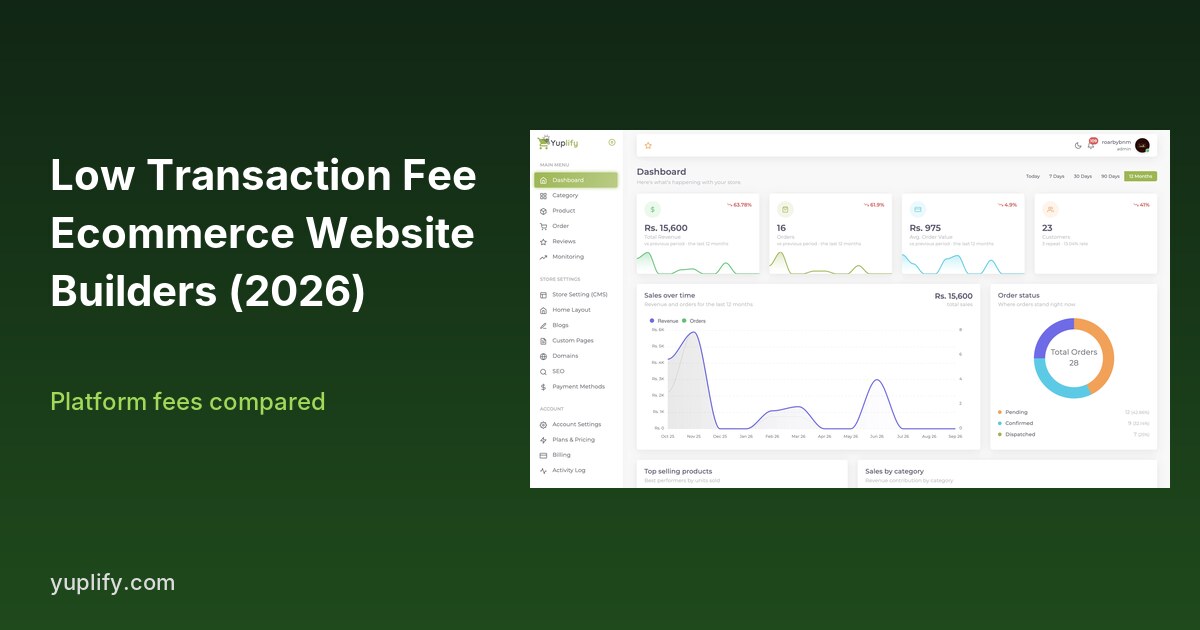
A straight comparison of the best e-commerce website builders in 2026 — what each one is genuinely good at, who it suits, and where it gets expensive.
There is no single best e-commerce website builder — there is the best one for your catalog, your budget, your technical comfort, and where you sell. Any list of the top e-commerce website builders is really a list of trade-offs, so this comparison covers what each one is genuinely good at and where each gets expensive or frustrating. Use it to shortlist two or three, then build a test store on each before you commit.
How We Compared Them
We looked at the setup experience, design control, the true cost including transaction fees and apps, payment and shipping flexibility, mobile experience, SEO capability, and how hard it is to leave. We did not score on feature-count — a long list of features you will never use is not an advantage.
The Top E-Commerce Website Builders at a Glance
If you only read one section, read this one — then jump to whichever two sound like you.
The Criteria That Actually Matter
Yuplify — Best Free Builder for Small Businesses
Good for: small business owners and first-time founders who want a professional store without code or a big monthly bill.
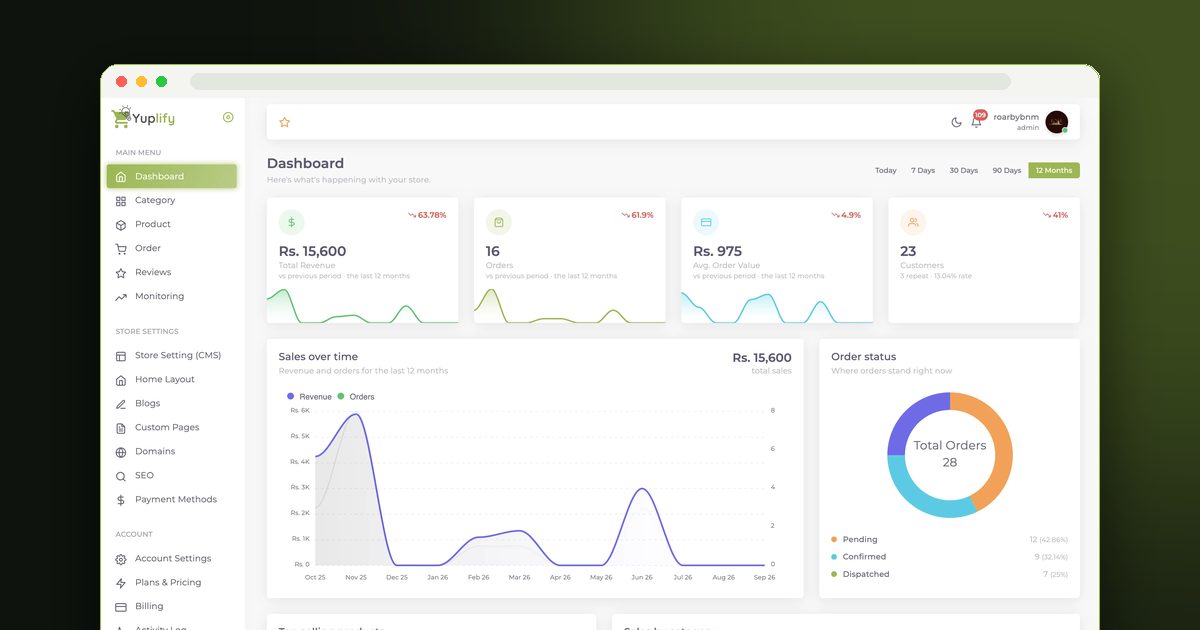
Yuplify's free plan is a real store — one storefront, up to 30 products, free subdomain, SSL — and there are no transaction fees on top of your payment gateway. The paid plan adds a custom domain, unlimited products, all 7 themes, SEO tools, card payments and TCS / Leopards courier booking for a flat monthly fee. Trade-offs: the free plan caps products at 50 and uses a subdomain; very large or highly custom catalogs will want to test the paid plan first. See the Yuplify eCommerce website builder page.
Shopify — Best for Scaling Fast
Good for: stores that expect rapid growth and want the largest app ecosystem.
Shopify is the most mature platform, with a huge selection of apps, themes, and agencies. Trade-offs: unless you use Shopify Payments, it charges a transaction fee on every order; a serious store often ends up paying for several apps each month; and total cost climbs steadily as you add capability.
WooCommerce — Best for WordPress Owners
Good for: people who already run a WordPress site and want full control.
WooCommerce is free, open-source, and endlessly customisable, and you own everything. Trade-offs: you are responsible for hosting, security, backups, and updates; most stores need several paid extensions; and it takes real time to set up and maintain. It is the most flexible option and the least hands-off.
Wix — Best for Simple Catalogs and Content Sites
Good for: small catalogs attached to a content-heavy or service site.
Wix has an easy drag-and-drop editor and handles a small shop well. Trade-offs: e-commerce needs a paid Business plan; it is less suited to large catalogs; and you cannot change templates after publishing without rebuilding.
Squarespace — Best for Design-Led Brands
Good for: brands where visual polish is the point — makers, studios, premium goods.
Squarespace templates are consistently well-designed, so a store looks good with little effort. Trade-offs: fewer advanced e-commerce features than dedicated platforms, a smaller app ecosystem, and limited layout flexibility outside the template system.
Square Online — Best for In-Person Sellers
Good for: cafés, market stalls, and shops that already take payments with Square.
Inventory and payments sync between the physical Square register and the online store, and there is a free tier. Trade-offs: the free plan carries Square branding, design control is limited, and it is weaker for online-only brands that need a distinct identity.
BigCommerce — Best for Larger Catalogs
Good for: stores with big product ranges and complex catalog needs.
BigCommerce has strong built-in features and does not charge its own transaction fees. Trade-offs: the interface is more complex, the entry price is higher than most, and plans have revenue thresholds that force an upgrade as you grow.
How to Choose the Right One for You
Whatever your shortlist, build a small test store on each before committing. For the budget angle, see cheapest e-commerce website builders in 2026; for the no-code trade-offs, see no-code vs custom development.
More E-Commerce Website Builder Guides
Each guide in this series answers one question. Pick the one that matches where you are:
Final Thoughts
The best e-commerce website builder in 2026 is the one whose strengths match your situation and whose costs stay predictable as you grow. Every builder on this list is genuinely good at something; none of them is best at everything, which is why a ranked list of the top builders is less useful than an honest map of the trade-offs.
Small business owners who want a professional store without code or a cut taken from their sales should put Yuplify's free plan on the shortlist and compare it head-to-head with one or two others — see the small business page for that angle. If setup speed is your deciding factor, the easiest builder ranked by setup friction is the companion piece; for the full budget picture, how much an e-commerce website costs.

Abu Bakar Memon
Founder & CEO
Abu Bakar Memon founded Yuplify in Karachi in 2023 — the free eCommerce website builder for small businesses in Pakistan. He writes about starting and growing an online store — pricing, cash on delivery, couriers and getting the first orders — from building the platform Pakistani sellers use every day.
Ready to Start Your E-Commerce Journey?
Create your online store in minutes with Yuplify. No coding required.
Get Started Free